Svart Thread Milling inserts CNC cutting carbide tools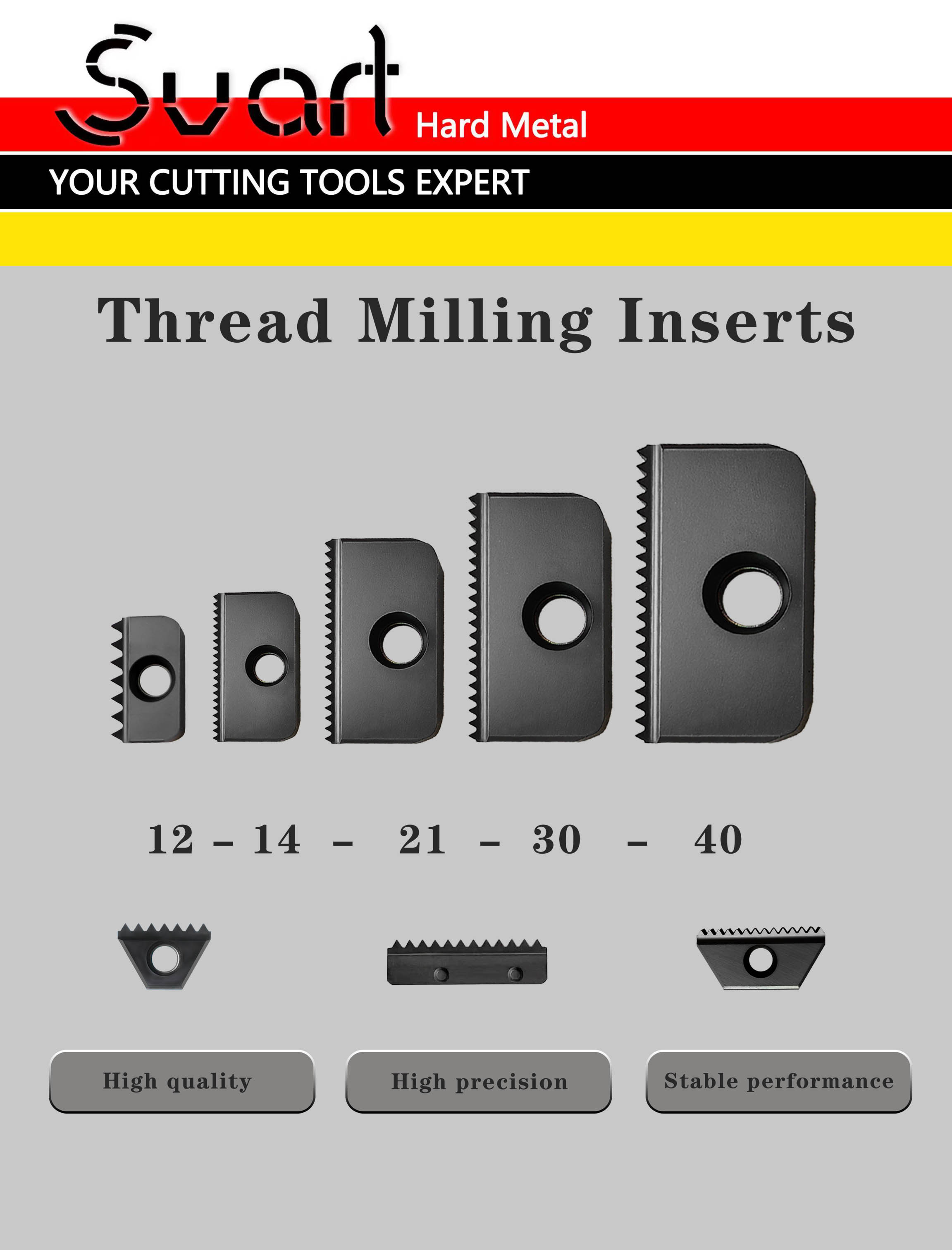
Thread milling is a machining process used to create internal or external threads on a workpiece. This technique utilizes a rotating cutting tool, which has multiple teeth, to produce thread profiles more efficiently and with higher precision compared to traditional tapping methods.
Key Features of Thread Milling:
-
Tool Design:
- Thread milling tools are typically end mills with specific thread geometries.
- They are designed to handle different pitches and diameters of threads.
-
Applications:
- Suitable for a variety of materials including metals, plastics, and composites.
- Commonly used in aerospace, automotive, and manufacturing industries.
-
Advantages:
- Versatility: Capable of creating threads of various sizes and pitches.
- Reduced Tool Wear: Thread mills can be re-sharpened and reused.
- Improved Accuracy: Offers better control over thread depth and pitch precision.
- Multi-Functionality: Can perform multiple operations such as drilling and milling within the same setup.
-
Process Overview:
- Setup: The workpiece is securely clamped in a CNC milling machine.
- Programming: CNC program is created to dictate the path and parameters of the thread milling operation.
- Machining: The thread mill cuts into the material in a helical path to form the desired thread shape.
-
Considerations:
- Tool selection: Proper tool geometry and size depending on the application.
- Machining parameters: Feed rate, spindle speed, and depth of cut must be optimized for the material and thread type.
- Toolpath strategy: The choice of a suitable milling strategy is essential to ensure quality and efficiency.
Conclusion
Thread milling is an efficient and flexible solution for creating high-precision threads in various materials. Its ability to replace traditional tapping methods in many applications makes it a valuable technique in modern manufacturing.


